How Is Insulation Made? A Plain-English Guide
Most homeowners know insulation goes in the ceiling and walls, and that it keeps the house warmer in winter and cooler in summer. But what’s it actually made of — and how does it do what it does? Here’s a straightforward look at how the most common types of residential insulation are manufactured, and why it matters.
How Insulation Works (The Short Version)
Before getting into manufacturing, it helps to understand the basic principle. Insulation works by trapping air. Still air is an excellent thermal insulator — it doesn’t conduct heat well. Insulation products create millions of tiny air pockets within their structure, and those pockets slow the transfer of heat through your ceiling, walls, or floor.
The measure of how well a product does this is its R-value — the higher the R-value, the greater the resistance to heat flow, and the better the insulation’s performance.
Glasswool (Fibreglass) Insulation
Glasswool — sometimes called fibreglass insulation — is the most widely used type in Australian homes, and the product you’re most likely to encounter in a standard ceiling or wall installation.
How it’s made:
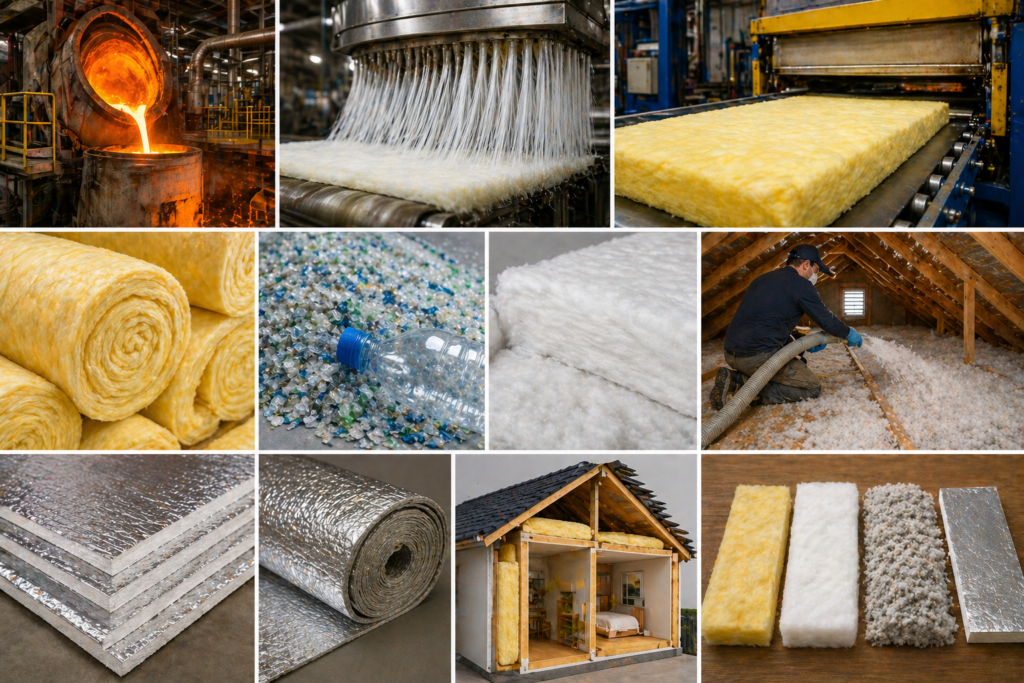
The process starts with raw materials: silica sand, recycled glass (typically 80% or more recycled content in modern products), and small amounts of other minerals. These are melted together in a furnace at around 1,400°C until they form a liquid glass.
The molten glass is then spun — similar to the way fairy floss is made — through thousands of tiny holes at high speed. This creates extremely fine glass fibres, each about the diameter of a human hair or thinner. These fibres are sprayed with a binding agent to help them hold their structure, then collected and formed into a continuous mat.
The mat is then cured in an oven, cut to the required dimensions, and compressed for packaging. When you unroll a batt on site, it expands back to its full thickness — that loft is what creates the air pockets that give glasswool its thermal performance.
Australian brands like Bradford Gold and Knauf Earthwool both use this process, with each having their own formulations for binder and fibre diameter that affect softness, performance, and handling characteristics.
Polyester Batts
Polyester insulation is made from polyethylene terephthalate (PET) fibres — the same base material as plastic drink bottles. In fact, many polyester insulation products are made from a high percentage of recycled PET, making them one of the more environmentally friendly options available.
How it’s made:
Recycled PET is shredded, cleaned, and melted down. The molten material is extruded through fine spinnerets to create fibres, which are then crimped and bonded together using heat — no chemical binders are required. The result is a soft, lightweight batt that’s similar to glasswool in appearance but noticeably different to handle.
Because there’s no binder and no glass fibre, polyester batts don’t cause the itching or irritation that some people experience when handling glasswool. They’re a popular choice for households with respiratory sensitivities, and for DIY installers who prefer to handle the product without full PPE.
Performance-wise, polyester and glasswool batts of the same R-value perform comparably in service — the difference is mainly in manufacturing, handling, and price (polyester is generally a little more expensive).
Loose-Fill Insulation
Loose-fill insulation — also known as blown-in insulation — comes in two main varieties: glasswool loose-fill and cellulose.
Glasswool loose-fill is manufactured similarly to glasswool batts, but without the binding process. The fibres are left loose and packaged in bags, then blown into place using a machine on site. This makes it particularly suited to existing homes where batts can’t easily be laid — the blown fibre can fill around joists, pipes, and other obstructions.
Cellulose loose-fill is made primarily from recycled newsprint and cardboard, treated with fire retardants and pest deterrents (typically boric acid). It’s a low-embodied-energy product and performs well thermally, though it’s less common in new residential work in Australia than glasswool options.
Foilboard and Reflective Insulation
Not all insulation works by trapping air. Reflective insulation — including foilboard products — works differently: it reflects radiant heat rather than absorbing it.
Foilboard is manufactured by bonding a layer of aluminium foil to a rigid foam core, typically expanded polystyrene (EPS) or extruded polystyrene (XPS). The foam provides some bulk insulation value, while the foil facing reflects radiant heat — making it effective in roof spaces and wall cavities where radiant heat transfer is significant.
The foil facing is produced by rolling aluminium to a very thin gauge, then laminating it to the foam substrate under pressure. The result is a rigid, lightweight board that’s easy to cut and handle on site.
Why Manufacturing Quality Matters
Not all insulation is created equal, even within the same product category. Fibre diameter, binder quality, and density consistency all affect real-world performance. Reputable Australian-approved brands are tested to AS/NZS 4859.1 — the Australian standard for thermal insulation materials — which sets minimum requirements for R-value accuracy and product consistency.
When you’re paying for R4.0 ceiling insulation, you want confidence that it’s actually delivering R4.0. Choosing products from established manufacturers and having them installed correctly — no gaps, no compression — is what makes the difference between insulation that performs and insulation that just sits there.
EasyFit Insulation supplies and installs leading Australian-approved insulation brands across Greater Sydney, the Blue Mountains, Wollongong, and the Central Coast. If you’d like advice on the right product for your home, we’re happy to help.
Call 0431 526 231 or get a quote online.